Thursday, October 27, 2011
Fish Bowl
Just A Girl I Used To Know
But that was a long time ago. They had come and gone since with no significant upset, merely a hobby and barely worth mentioning. He carried on with life, more like the victim of a bad haircut than an amputee. He had lost something, no doubt. But until today, he had never really thought about it. It had nothing to do with her, though in passing he might have convinced himself otherwise. A creative fire, once devastatingly beautiful and fueled by an endless cycle of observation and fusion, had finally reached a point just past the horizon. It was dying.
Like the innocent victim of lethal disease, the knowledge of the existence of an end contributed in hastening it onward. Wasted canvases betrayed the stillborn ideas, suffocating in their lack of momentum. He was tired.
But this was his swan song. A masterpiece. His magnum opus. Her long, brown hair fell past her shoulders and a soft smile cast its shadow across the face of the sun. He painted her not as she was, nor as she had been. He painted her as he remembered her from a lifetime ago. And although that same lifetime may have distorted his memory, it made no difference to him. Here was a reality more tangible than anything he’d ever known. There she stood at the top of the hill, basking in the halo Helios himself placed upon her head. She looked down with mercy and compassion at the mortal below. He returned her gaze. Filled with sorrow for past sins, he returned to the religion of that summer and readily reassumed his role as zealot. This graven image, crafted by his own hand, made him an idolater once more. With every brushstroke, he disappeared more and more into his creation and withdrew further from the cold academics’ reality. He felt the grass between his toes. The sunlight danced on his skin and a gentle breeze tossed their hair. He could see the lake in the distance.
The breeze became a howling gale. Helios fled as the thunderheads rolled in. Roaring across the lake, lightning impaled the air and he watched helplessly as she ran down the hill for shelter. Desperate as he was, he lost her the light that flashed right in front of him.
“Who is that?” she asked, cracking the sky and closing the door behind her. The world around him shattered and fell away to reveal the studio. She sat the brown grocery sack on the counter and walked over to admire his latest work.
“Oh, no one…” he said nonchalantly with total disregard for his racing heartbeat. “Just a girl I used to know.”
Tuesday, June 14, 2011
He Needed Peace
The river was a place of peace and always had been. The setting sun seemed to float downstream, disappearing beyond the horizon. A gentle breeze wandered aimlessly along the bank, hopscotching over and around every irregularity in the landscape. Like the nocturnal old drunks that seemed omnipresent downtown, it had nowhere to be; only the past to run from.
He was running. His eyes strained for a glimpse on the goal he feared he’d never reach. He could hear it gurgling faintly through the trees. He needed peace.
Panting like a dog roasting the in July sun, he refused to look back. He didn’t know who or what he was afraid might be chasing him but he knew that looking back might just force him to find out. Acknowledging whatever’s or whoever’s existence would give it more power than he had the power to stand against at the moment. He was exhausted.
The day had been long and the night before even longer. His memory got fuzzier from there but he figured that was kind of the point. It seemed that time lost its meaning. In the moments when his mortality forced him to pause for breath, rest, and contemplation, colors seemed to shift before his eyes and he couldn’t help but feel that he was dreaming.
That terrified him like nothing else. He’d long dreamt of escape and many a night had passed in silent, inner turmoil. From the first snore that ripped though the darkness and his eardrums until the first light of the new day poked through his eyelids, he’d wrestle with the angel and the devil. Waking only promised the agony of the day before.
When he could finally stand it no longer, the spirit descended on him. He rose and his legs carried him outward and onward of their own accord. They moved him across the ground faster than he’d ever imagined possible. He could only imagine they grasped the severity of the consequences should his escape fail.
The nighttime buzzed with life as he had never known. He saw tiny, glowing eyes in the periphery that disappeared before he could turn his head without fail. Every snapped twig or rustled leaf made him jump. His heart would skip, forcing him to pause. The rest he found in these moments was never comforting. He knew he needed it but he hated it just the same.
In the stillness, his loneliness would begin speaking to him. The rustling leaves grew louder and busier, and, if he strained his ears enough, he swore he heard dogs barking excitedly. They were always distant, though they were slowly creeping closer. Powerful as his imagination was, he was almost sure that’s all they were. It was the tiny part of him that wasn’t so sure that drove him steadily onward.
He was finally to the river. He burst forth from the woods and it lazily wound around the bend until it disappeared again beneath the sun-scorched horizon. The sparse clouds swirled across the purple sky as if written by God Himself. For the first time, he understood how the ancients came to worship the light, even as it dropped of the face of the earth; possibly to never return again. For him, the journey to and fro oblivion was no less mysterious or divine in that moment.
He’d brought as little as possible with him but, even then, it was too much. Certain things were following him; the very things he’d sought to leave behind. They were the same things he was running from.
He paused for just a second to survey the scene. The drunken breeze rustled his hair reassuringly and his lungs overfilled with air. He drank in the sunset.
The orange ball seemed within his grasp. The space between was intoxicating. He felt himself floating. He was airborne. Higher, higher, higher he rose. Just short, he fell. His outstretched arm strained to be long enough. The sun seemed to mock him with its unwavering stare as he fell away. Once again, he felt all too mortal.
The waters threw their heads back, rolled back and forth by raucous laughter. He went limp as the first drops splashed around his legs. Gasping for air, the water swallowed him whole.
Tuesday, April 12, 2011
The Poet and His Plagiarist (Part 1)
The view from his corner of the small cafĂ©’s patch of sidewalk was blocked by the floppy yellow umbrella that sagged above and around the table like an overprotective mother. For the first time in a long time, it was a sunny day. Somehow the shadows felt more natural to him. Besides, the umbrella was bright enough on its own. His head was beginning to ache. He was waiting and beginning to get anxious.
His thick sunglasses hid the bags under his eyes. He wore an insincere half-smile to draw attention away from his pale, unshaven face and his disheveled clothing. He didn’t smoke but a burning cigarette hung between the index and middle fingers on his right hand regardless. It was all a front. He wore it for the people because it’s what they wanted.
He’d always wanted to be a wordsmith of some kind. He’d read unceasingly. He began with the works under the “Classics” banner and worked his way outward. He moved from prose to poetry and back again, spending some time reading about the men and women who still drew breath in the white spaces between the words. He’d even been inspired to give writing a shot himself.
He soon realized the romanticized image of a writer was silly. They’d often been painted as something more than they had ever been or would ever be. They were the mirrors of their world but not the world at large. In his experience, writing meant spending a lot of time alone, trying to find the dividing line between loneliness and solitude.
He’d written for a long time before he actually produced anything worth mentioning. Angsty journals had filled his bookshelves until he’d burned them all at friend’s bonfire one night. That bonfire was historic for many reasons. He met her for the first time that night.
He rode back to his parents’ house right on the edge of the next morning, feeling oddly. He’d collapsed on he bed without bothering to pull back the sheets. As the birds of the early morning began to tweet and chirp, he felt the weight of the night before on his eyelids and in his heart.
Before he could entirely surrender to the weariness in his bones, something moved within his chest. A light in his soul roared to life as if switch had been flipped. His hand scrambled around in the darkness until it found his lone remaining notepad and, after a few moments of groping blindly in the night, a pen. Even now, he couldn’t recall what happened afterward until he awoke the next afternoon. The notepad on the floor beside his bed lacked a page or two of being full.
He bumped into her at school Monday morning. Their respective armloads of books went flying. After a moment of awkward silence and the meeting of the eyes usually saved for a Mexican standoff, they both burst into maniacal laughter as they gathered their spilled luggage. The rest of their time together went like something out of a book he had read in his youth or one of the movies made from the book.
They’d been companions more or less since their hallway collision. He’d later write that, as harmless as it seemed, that accident ended two lives. Yet far from a tragedy, they had fused.
She’d read his work, not knowing that many of those early poems were about her in one way or another. They were good. He’d felt it when he read the first batch the day after the bonfire, but she was emphatic. When they’d finally been accepted for publication and he’d expressed his disbelief, she’d shot him a look that, while only expressing her undying confidence in him, reminded him how dumb he could be sometimes. He’d gotten the same beam of sunshine when the first check arrived in the mail.
She wrote too. He was far more prolific but every word she committed to paper was saturated to the point of dripping with the same beauty, profound meaning, and grace of her every movement. She was better than he could ever hope to be and loved her all the more for it.
They decide that some time apart would do them both good after such a long time together in high school. Their first semester at the local university quickly turned into a failed experiment in “space”. Over winter break, his first collection and her first novel were picked up for publication. When they married in the late spring, the only surprised people were those who had assumed it had already happened.
They both wrote and became more successful than they’d had any right to dream of. They rose to name recognition and were more than happy to keep their physical anonymity in their tiny hometown. In the rare quiet times, they spoke some about their plans for the future and the possibility of children (which they both wanted eventually). They knew they were young and they were in no hurry to rush into anything. They had their whole lives ahead of them to worry about those kinds of things. But then, shortly after the release of her fourth novel and right before the relase of his sixth collection, she found out she was pregnant. It was like the hallway collision all over again.
They began making plans and talking about names and trying to decide who would give up their office for the nursery. He felt that the light that had turned on after the bon fire so long ago was burning twice as bright. Looking at her and sensing the glowing aura wrapped around her body, he knew that she felt exactly the same.
One night they went to a friend’s house for a party celebrating his winning of one award or another. The friend was a man of means and exquisite tastes. Dinner was marvelous and the conversations in the soft candlelight took on a magical quality as the hour grew later.
As they drove home on the edge of the next morning, she fell asleep. With her breathing softly beside him as they twisted and turned on the backcountry roads, his mind began to wander. He thought back to another night, long ago, when he’d driven the same path at the same time, all the while thinking of the same girl. He smiled to himself. He thought of all the good times since and the wide-open possibilities for the future. He thought about how fortunate he was to have his muse as a constant, in-the-flesh companion and he worried about what kind of father he was going to be. Would he be too distant? Too present? Too strict or too lax? He rounded a sharp turn with his hands firmly gripping the steering wheel. He didn’t see the headlights slide drunkenly onto his side of the road until it was too late.
Thursday, March 24, 2011
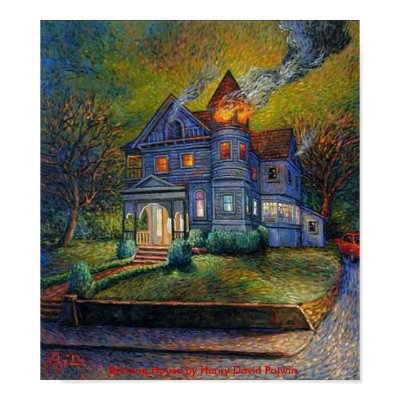
Burning House: a poem

An insurance salesman, a philosopher, an economist, and a pyromaniac (a hobby; he’s currently bouncing back and forth between a few contractors for work) walk into a bar. They’ve all had a long day and the silence is dense enough to be comfortable. It hangs around and between them, cloudlike, until the pyromaniac turns to the rest of the group and asks, "How much is a house worth when it's burning to the ground?"
A ripple shoots through the airs, shattering the tired stillness of the room. Each of the men stirs as the shards of echoing sound hit him. Tiny enough to sting just a little at impact, it shakes each man awake. “What?” asks the insurance salesman as the clouds part from in front of his eyes.
The pyromaniac repeats his question and the men look at him, puzzled. The insurance salesman, a simple man who enjoys the sound of his own voice, laughs and says, “Well… I guess it depends on the policy the homeowner has.”
The pyromaniac sits quietly, staring off into space. The economist, highly educated with an ego just as inflated as his grades had been, decides to fill the silence and says, “In this economy, it’s probably not worth anything while it’s still standing.” He looked at the insurance salesman and smiled. “If I were you, I’d definitely be investigating the homeowners.”
The insurance salesman laughs again and says, “That’s kind of our standard operating procedure. Our clientele is usually pretty oblivious but every once in a while someone can be convinced they may have forgotten to turn the stove off.”
“What about people in lower income neighborhoods? In my experience, they usually remember things like that,” said the economist.
The insurance salesman snorts and, after a moment, wipes the tears from his eyes as he gasps for breath. “Even if they could afford it, they know their crap isn’t worth insuring!”
The economist can’t help but smirk. The philosopher, a man of somber disposition, ignores the larger implications behind the joke and asks, “Is there not value in any kind of house? The shelter it provides from the elements must be worth something or houses wouldn’t be worth anything regardless of their status as charred or not. Think of the homeless. Don’t they desire a home of any sort to shelter them form the elements? If you’re going to say more modest homes aren’t worth anything, then you have to agree that larger homes, which only differ in giving the inhabitants more space to themselves, are worthless as well. If space is the primary source of value, then the homeless would be the happiest.”
The pyromaniac’s empty glass clinks as he sets it down on the laminated bar. “That’s an interesting point. I was just going to say that it was only valuable as it was burning. You can’t buy entertainment like that.”
With that he waves to his friends, spins around on his stool, and walks outside. Through the door, his friends watch as he disappears into the night and shiver at the blast of cold wind that rushed in behind him. Moments later, the fire alarm begins screeching and the panicked bar patrons run out to find their home away from home lighting up the night sky like a mighty torch.
Thursday, March 10, 2011
The World Is On Fire
The world is on fire. The flames are invisible but only burn all the hotter for it. Since the beginning, we’ve crawled out of the ooze from which we’re born, sopping wet and mercifully coated with a protective layer of the liquid still clinging to us. The coats vary in thickness, some more uneven than others. The flames lick at us but all they taste is the ooze for a while. The ooze doesn’t last. With each fiery kiss, some of it evaporates away, becoming a cloud that will one day rain over the pool of our origin and give a new life its chance.
Eventually the flames burn through. It’s a subtle change because the layers melt away one at a time and it gets hotter inside each time. Yet when it happens, we know without knowing that it is over. Our time is not immediately over but we feel the burn, numbing our senses, and nothing can be the way it was before. Our chances to live, love, learn, and explore have slipped away through our fingers like the waters of a lazy creek. The End comes when it will, as a thief in the night. We know only that it is impending by the bitter taste of our every breath. Smiles fade quicker and don’t mean as much as they did before. One day we all look past the rain and the life it brings and see only the mud upon which it all rests. Hollow laughter echoes through the empty hallways of our dwelling places and we dissolve with the sound. The blurry, dull edge to the world becomes little more than dead wait, preparing the burdened for their rest.
The thickness of each coat is apportioned by luck alone to each individual. A heavy, even coat is granted to some, gifting them with long life and good health. Some are given a heavy coat, thinner in some places than in others. This results in a long life, though the exposed areas bring problems that will eat away at the physical body long before its time to go. There are an unfortunate few given a sparse coat if any at all. These are the poets, prophets, and mad men of the world. From the first breath, they feel the fire eating away at them. They know that The End is just as much a part of our life as the first breath that announced The Beginning.
Sunday, February 13, 2011
The Roommate: A Horror Story
Chester kicked the lowest step, hoping to knock the snow from his shoes. He hated winter. His teeth chattered and his hand shook as he tried to guide his key to the lock. The warmth on the other side of the door seemed to be taunting him.
He heard the sharp click and his clumsy, gloved hands scrambled for the doorknob. He leapt inside and slammed the door behind him in Jack Frost’s hideous face. The wind howled as it blew across the covered porch. He flipped the deadbolt and collapsed on the couch. He was cold, hungry, and exhausted.
It had been an extremely long day. His first class had started at 7 o’clock sharp that morning. Within ten minutes, he’d watched helplessly as the snow began to fall steadily, filling in the space between the surviving mounds from the last storm.
He trudged from one building to the next with his head held down against the tiny white flakes that stung his face. Little white specks covered the front of his coat before melting away.
After lunch, the hours at his on-campus job seemed to drag on for years. There was never enough movement to consider himself busy, yet naps were always interrupted as soon as the thought entered his mind. Like his father, his dark brown hair began showing silvery interruptions at an early age. Unlike his father, his had started just before his twelfth birthday and spread like shattered glass. Chester didn’t look in the mirror much because it only reminded him that he wore it all just as heavily on his face. The work study job didn’t help.
He was finally home. Or as close to home as he had anymore. Moving from one parent’s house to the next and then back to school again, he felt like a transient. The constant motion gave the world a blurry look and kept him from establishing any permanent type of anchor. It was unsettling in the best of times and nauseating in the worst.
He lay in a puddle on the couch for a long time. Hunger began creeping in from the periphery of his vision until it finally moved him to swing himself up onto his feet and mosey into the kitchen. He opened the refrigerator and crouched to see what delicacies were waiting for him. He was horrified to find a few pieces of cheese and some pasta from the week before the only things that greeted his eyes.
For the past two weeks, Chester had been readjusting. His roommate from the previous three semesters decided it was time to take a break from school and “find himself”. Chester was skeptical of any enlightenment found while waiting tables at a sports bar but he certainly wasn’t going to say anything. His new roommate was from way up north. Even after a fortnight, they were still trying to hash out a way through the language barrier.
Chester’s new roommate was a classical pianist. In his room, he’d play beautifully for hours, filling the whole apartment with lush sound from his keyboard. He always seemed to be on his way to meet up with friends to “compose some music”. Chester would joke with his friends that he was afraid he’d come home some day to find his apartment littered with musicians, sheet music and powdered wigs.
Chester loved music and had little problem with the incessant practicing. More often than not, he enjoyed it. What Chester did have a problem with was his new roomie’s habit of staying up through the night, periodically breaking the cover of his room to eat whatever he could find in the apartment. Chester had been waking up to find more and more of his food disappearing. Just yesterday Chester had politely given a verbal cease-and-desist request. Clearly, the apologies and assurances that it wouldn’t happen again hadn’t meant anything. They’d established early on a system of alternating who bought the things they both used (paper plates, toilet paper, etc.). He’d hoped that any of the other’s foods one might happen to eat would logically fall into this category. No dice. The grocery list on the side of the refrigerator was long and arrogant.
His roommate was gone. Chester dug through cabinet after cabinet until he finally found a package of two Pop Tarts. He was hungry enough that he didn’t care. After “dinner”, he began to look around the common areas of the apartment, taking stock of the damages. He was about to use the bathroom when he noticed they were out toilet paper and running extremely low on liquid hand soap.
Chester, angrier than he had words to describe, threw his arctic gear, still wet, back on and grabbed his keys. He slammed the door behind him and began planning exactly what he would say when the time came. This was too far. His teeth were chattering again by the time he heard the deadbolt click again.
His mind was racing as he walked towards a friend’s apartment down the block. It had been one of those days for the past week straight.
Chester stepped up to the door and knocked three times in rapid succession. Before his knuckles rapped against the door the third time, it hit him like a freight train on a tight schedule. All of his angst intensified and immediately spun in a new direction. It was his turn to go shopping.